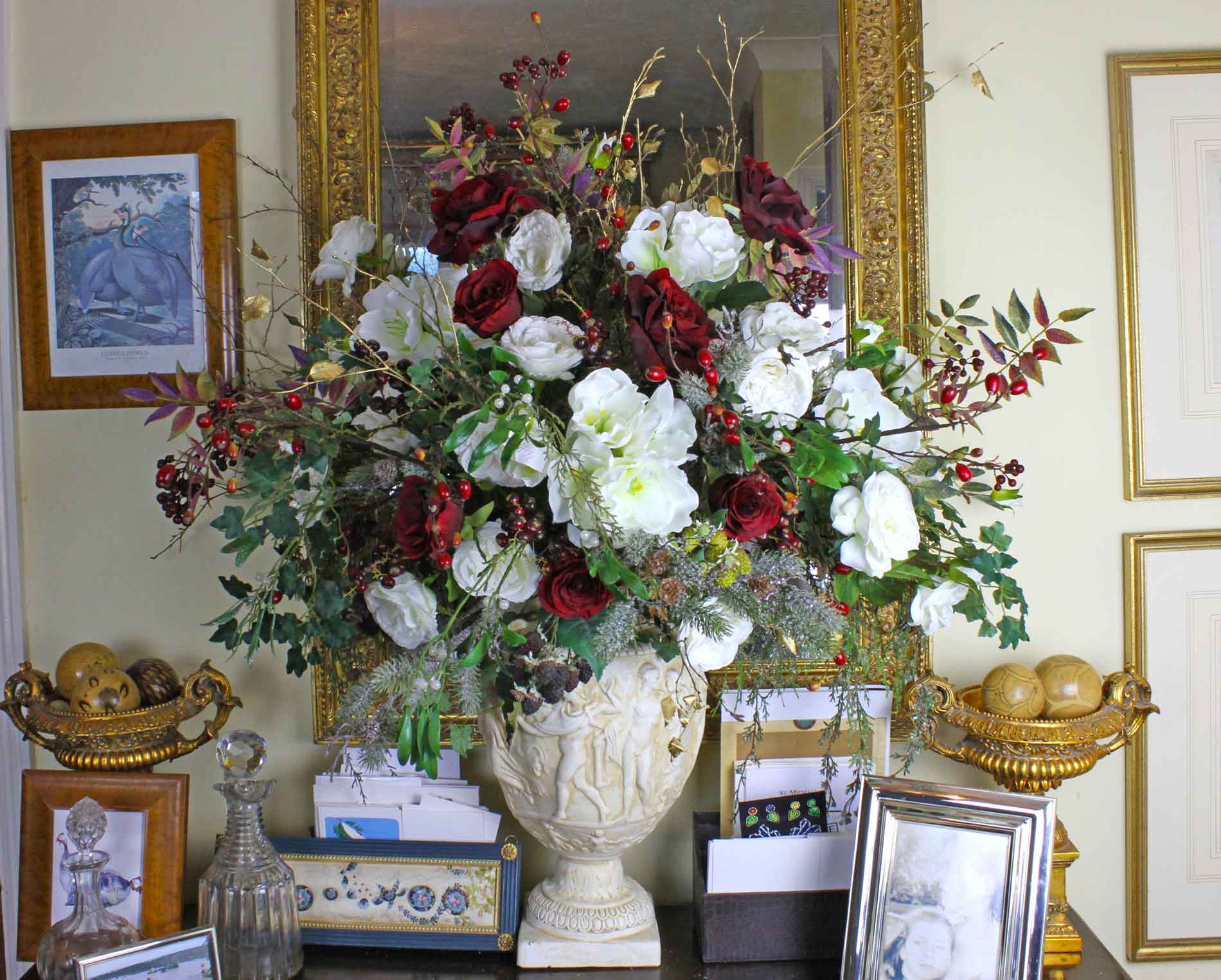
In 2016 a veritable rash of rather supercilious (in some cases) articles appeared debating the merits or otherwise of real or artificial or faux flower arrangements. Some of these were highly complimentary and some as disdainful and dismissive as ever of fake flowers.
This post is partially to address some of the issues raised in the discussions and I shall enlarge upon some of the points in later posts about faux flower arrangements.
I have worked with both resembling and real flowers nearly all of my life and I firmly believe there is a place for both in this world. A belief clearly shared by the Queen of Sheba when she invited Solomon to distinguish between real and representative flowers to test his wisdom. Can there be a more telling testimonial than that?
So if you do succumb to the undoubted charm of silk flowers, I follow a few rules in my work with them which may interest you.
The Ten Commandments of Faux Flower Arrangements
1. Seasonal
As far as possible use flowers that are naturally in keeping with the time of year, for instance, for January to March, Hellebores, Amaryllis, Snowdrops, Fritillaries and twigs.
2. Stylish
When working with fake flowers one has to be very clear about style, and make a decision early on in the arrangement process – do I want this to look natural and realistic or does it want to be more “designer” or “couture” in its style?
3. Spectacular
Spectacular displays do very well with artificial flowers, even competing well on cost grounds, given the enormous expense of hundreds of real flowers. They can be particularly striking when combined with real trees and foliage so that it is unclear what is real and what is representational.
4. Special
All flowers, whether real or otherwise, benefit from being very good quality and to be handled with care and appreciation. One no more wants a misplaced silk petal that looks awkward, than a bruised rose. Always check for the tiny details.
5. Specific
The best silk or parchment or paper or other unreal flowers are those which mimic real flowers most closely in their attention to detail and are so beautiful that they bear comparison with the real thing, I do not really regard them as a substitute, but as an art form in their own right.
6. Social
Unreal blooms are especially useful in situations where real ones are either unsuitable or undesirable. Hospitals, for instance, no longer allow fresh flowers on the wards, so a bunch of freshly bright fakes might well light up the long dreary hours of the hospital routine. If people are highly allergic to real pollen or scents, the pretend botanicals can be extremely good presents that express the same sentiments.
7. Simple
Simple is often best. A single orchid or one type of rose, a grouping of amaryllis with carefully chosen contrast material and good quality moss and twigs, for instance, can say just as much as a busy faux flower arrangement.
8. Subtle
The most outstanding flowers are those which not only look true to nature but possess the most subtle of hues and botanical detail. Many is the time I have abandoned the Pantone dictat to unloose the watercolours to copy as exactly as possible the delicate shades of the hellebores from the garden or the violets from the wood.
9. Suspect
As much as possible let’s keep them guessing like the Queen of Sheba! Sometimes it is very hard to tell the difference between fake and real flowers from a distance or when faux flowers are mixed with real foliage and berries - but the giveaway is of course…
10. Scented
So many times our clients have exclaimed that “They are so gorgeous and realistic, the only thing missing is the smell!” We scent, on request, our bunches with rose hydrolats and lavender oils so as to further perpetrate the unique experience of receiving a really luxurious and carefully presented bouquet or arrangement.
Solomon’s answer to the Queen was apparently that the real and unreal flowers could be detected by a simple visitor - the bee - who would only alight upon the real scented blooms.
With Ellie White's scented faux flower arrangements we really do have bees, if not in our bonnets, on our flowers. The delicate rose hydrolats have been known to attract bees to visit our silk flowers!
We just might have Solomon stumped there!