
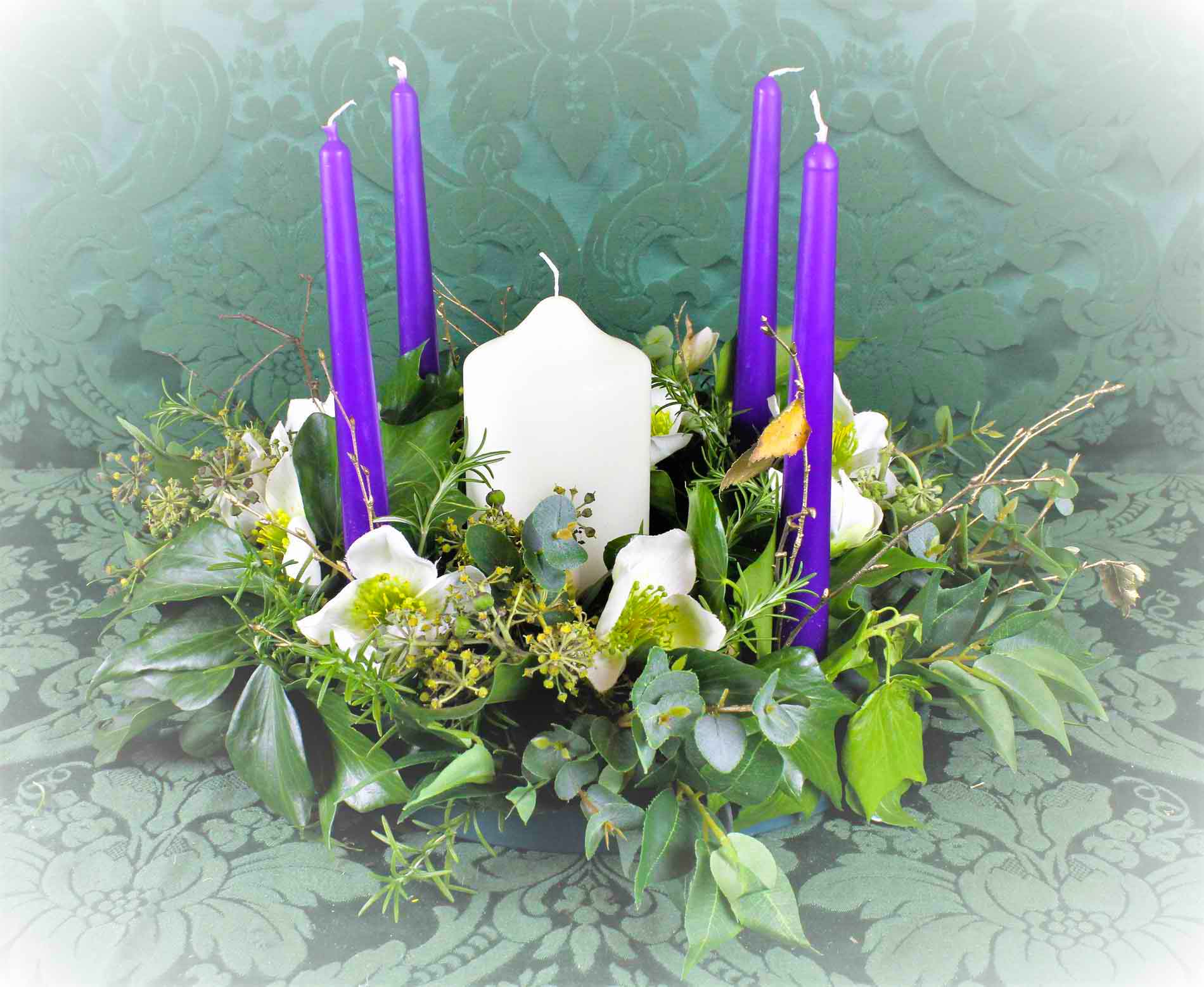
The traditional Christmas Wreath takes the form of a circle which has numerous meanings the roots of which go back to Pagan times way in the deep past even beyond the Egyptians.
The circle has no beginning and no end, it is endless and whole in itself. Our very sun which allows for life on this planet is a circular shape, as are the other planets. The shape is both in motion and always motionless for it has no end. It is the “still point of the turning world” in T.S. Eliot’s phrase in Little Gidding, the first poem in The Four Quartets. He perhaps more than any other modern poet wrote in the language of the mystic and the seer and also understood the curious nature of our Winter’s fiery, icy still turning point when time not only stands still but turns back inward on itself:
Little Gidding
Midwinterspring is its own season
Sempiternal though sodden towards sundown,
Suspended in time, between pole and tropic.
When the short day is brightest, with frost and fire,
The brief sun flames the ice, on pond and ditches,
In windless cold that is the heart's heat,
Reflecting in a watery mirror
A glare that is blindness in the early afternoon.
And glow more intense than blaze of branch, or brazier,
Stirs the dumb spirit: no wind, but pentecostal fire
In the dark time of the year. Between melting and freezing
The soul's sap quivers. There is no earth smell
Or smell of living thing. This is the spring time
But not in time's covenant. Now the hedgerow
Is blanched for an hour with transitory blossom
Of snow, a bloom more sudden
Than that of summer, neither budding nor fading,
Not in the scheme of generation.
Where is the summer, the unimaginable Zero summer?
The Four Quartets, 1942
This for me represents the true heart of not only the winter and the stark but reassuring awareness of the seasonal cycle and renewal, but the conundrum that lies at the very heart of our existence. In death we are in life, in summer, the winter will inevitably come, Christ died so that we may live.
The Christmas Wreath sums up this polemic in the language of leaves and flowers and the natural world: that of ice and fire, life and death, and the hope and promise that in the now there is eternity, and that life is everlasting.
To this end to illustrate this I have created an ice and fire wreath of evergreens, which represent continuity and survival through difficult times, and icy branches and lights. Each evergreen used traditionally has a meaning (though these are always the subject of much debate):
- Holly represents the crown of thorns that Christ wore at the Crucifixion and the berries his blood.
- Pine, holly and yew symbolize eternal life.
- Cedar stands for healing.
- Laurel represents the conquest over pain and suffering.
- Pine cones, seeds and nuts represent birth and rebirth.
Whilst the traditional Christmas colours are red, for the blood of Christ, and green, to represent eternal life, I have chosen ice and fire in this Advent Wreath (which I wrote about last year) with icy branches, the Holm Oak and ivy, and the white hellebore, the Christmas Rose.
Ice and fire, water and sun, light and growth, cycles and time are all represented in our yearly celebration of the Wreath, so next time we see one let us pause and reflect upon the true symbolism of our Christmas decorations: the cycle of the seasons, life and death, and the nod to Blake’s notion of “eternity in an hour.”
Their meaning is more mysterious and deeper than perhaps our department stores may realize, but perhaps most of all when we decorate our houses nowadays with foliage, and twigs, and light and flowers, we are bringing the outside in at the bleakest but most hopeful time of the year.
At the risk of too much Eliot (!) Christmas and Midwinter are “intersection of the timeless moment” when “history is now and England”. (Little Gidding).
Moreover, ultimately, as we march forward through our celebrations toward the turning of the year and the renewal of the light, we might bear in mind perhaps the real meaning of the decorations in general, and the wreath in particular:
What we call the beginning is often the end
And to make an end is to make a beginning.
The end is where we start from.
T.S. Eliot Little Gidding 1942.