


Flamingo Fine Art Print
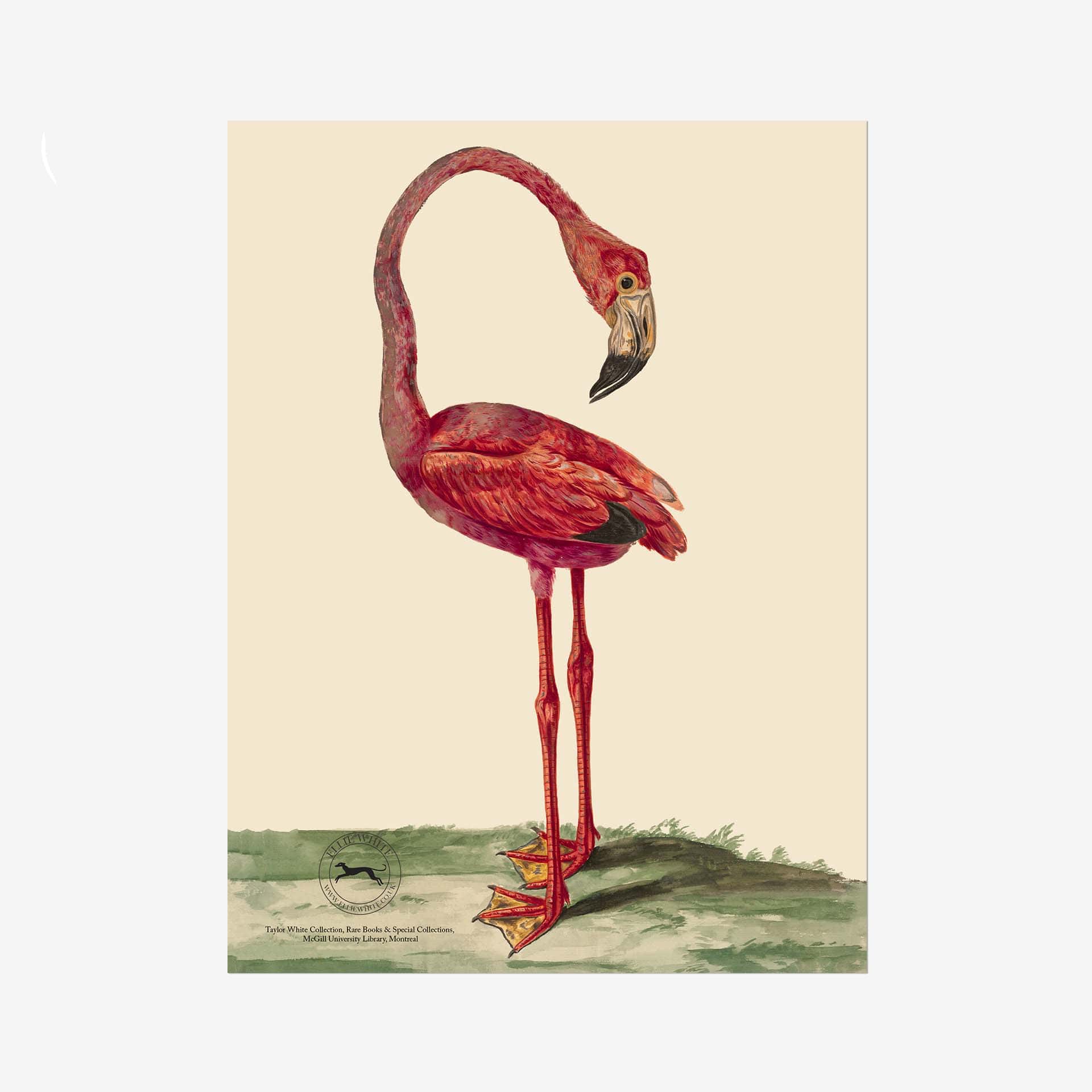
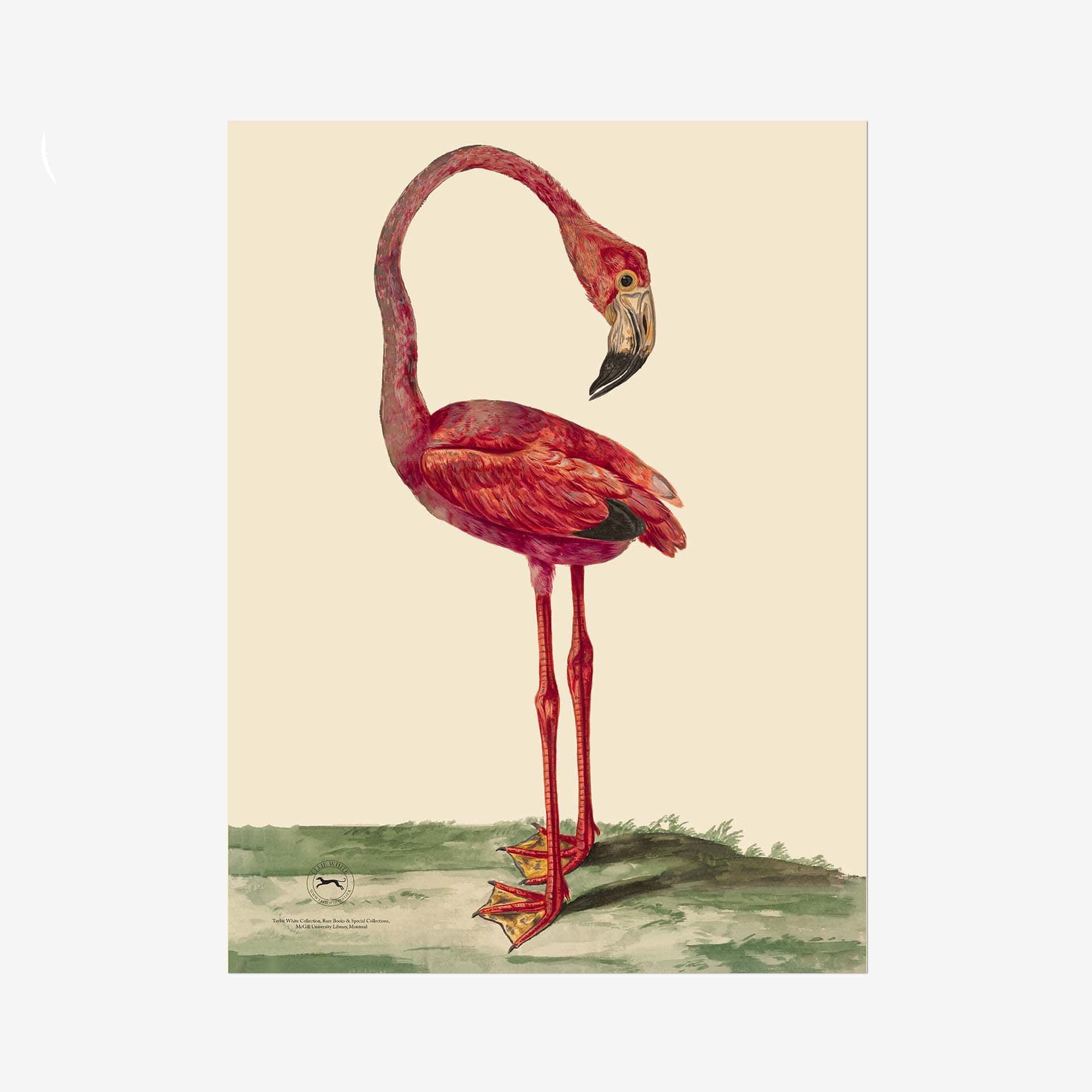
A high quality fine art print on Hahnemühle German Etching art paper of an American Flamingo, painted by wildlife painter Peter Paillou (c.1720-1790) in the 18th Century.
Superb Flamingo Fine Art Print on Museum-Quality Paper
We've meticulously reproduced Flamingo Fine Art Print on museum-quality fine art paper, matched to size. The 6in x 8in print is produced on Enhanced Matte Art Paper [EMA], a heavy-duty fine art paper with a smooth, non-reflective finish. The 12in x 16in and 18in x 24in prints are produced on 310gsm Hahnemühle German Etching paper [HGE], an acid and lignin-free archival paper with a fine tooth, offering our highest level of detail and longevity.
Both papers are fade-resistant and colourfast, using pigment inks designed to preserve the clarity and depth of the original artwork for decades. Every print is produced to order from a high-resolution master file, ensuring sharp detail and accurate colour reproduction.
* The Flamingo Fine Art Print is printed on premium 324gsm Mohawk fine art cardstock using high-definition archival inks for a museum-quality, crisp finish.
The Taylor White Collection's 18th Century Watercolour Painting of the Flamingo
Our Flamingo comes from the original collection of Taylor White F.R.S. (1701-1772). In the mid-18th Century, White commissioned the celebrated wildlife painter Peter Paillou (c.1720 - c.1790) to paint a number of specimens for his collection. The watercolour of the Flamingo was among the works Paillou produced for White.
The original Flamingo watercolour is finely painted, with remarkable detail, allowing the plumage and features of the Flamingo to be seen in stunning clarity. This depth of colour and detail has been captured brilliantly through the digitisation process and is replicated here for your home or office decor, or as a thoughtful gift.
Taylor White, a barrister by profession and later Puisne Judge for Chester, was a keen naturalist and Fellow of the Royal Society, elected in 1725. Over nearly forty years from the 1730s until his death in 1772, he commissioned 938 watercolours of birds, mammals, fish and reptiles, including the Flamingo, now held at McGill University and painted almost entirely by two artists, Charles Collins and Peter Paillou. White was a founding governor of The Foundling Hospital in London and served as its treasurer for the last twenty-five years of his life. His well-connected social and scientific circle gave his artists exceptional access to specimens: his second wife, Frances Armstrong, was the daughter of General John Armstrong, Governor of the Tower of London and Chief Royal Engineer, and White's artists painted the lions, wolves and other animals of the Royal Menagerie there. He also borrowed specimens from the British Museum, and received rare and exotic birds from friends, including the naturalist Joseph Banks, who sailed to Newfoundland in 1766, and William Harrison, who brought back specimens from voyages testing his father's marine chronometer.
The American Flamingo
The American Flamingo (Phoenicopterus ruber) is the most intensely coloured of the world’s six flamingo species, its plumage ranging from soft rose to deep vermilion. It is the only flamingo native to North America, and the largest of the New World species, standing between roughly 1.2 and 1.4 metres tall. Linnaeus described it in 1758. For much of the twentieth century it was treated as conspecific with the Greater Flamingo of the Old World, and the two are now generally recognised as separate species, the American being much the more richly coloured of the pair.
Where The Flamingo Lives
The species is a bird of shallow saline and brackish water: coastal lagoons, mudflats, estuaries and salt pans. Its range takes in the Caribbean islands, the Yucatán Peninsula, the northern coasts of South America and, in a long-isolated population, the Galápagos. It bred in southern Florida until the nineteenth century, when plume hunting effectively removed it, and birds have been recorded there again in recent decades. The global population is not considered threatened, though individual colonies are vulnerable to disturbance and to changes in water level at the few sites where the birds gather to breed.
Why The Flamingo Is Pink
The colour is entirely dietary. Carotenoid pigments taken up from algae, diatoms, brine shrimp and other small invertebrates are processed in the liver and deposited in the feathers, skin and bill. Birds deprived of those pigments fade to pale pink or white, which is why flamingos in collections are given supplemented feed. Colour is also a signal: the brightest birds tend to be the best fed and the most successful in courtship, and adults dull noticeably while raising a chick.
The Curved Bill
The bill accounts for much of the bird’s character. Bent sharply downwards near its midpoint, it is held inverted in the water and swept from side to side while the fleshy tongue pumps rapidly, drawing water through rows of fine comb-like plates called lamellae that strain food from the silt. It is a filtering apparatus closer in principle to the baleen of a whale than to the bill of most birds. The long neck and stilt-like legs are adaptations to the same shallow-water feeding, allowing the head to reach the bottom while the body stays clear of the water.
Standing On One Leg
The habit is still not fully explained. The two most persuasive suggestions are heat conservation, since a leg drawn up into the plumage loses less warmth to cold water, and a passive skeletal mechanism in which the joints lock under the bird’s own weight, allowing it to balance with almost no muscular effort. The two explanations are not mutually exclusive, and both have experimental support.
Colony Life
American Flamingos are intensely sociable. Colonies can run to thousands of birds, and breeding is preceded by synchronised group displays in which large numbers move together, stretching their necks, turning their heads in unison and flashing the black flight feathers hidden beneath the wing coverts. Nests are cones of packed mud raised above the waterline, each holding a single egg. Both parents incubate, and both feed the chick on a rich secretion produced in the upper digestive tract, tinted red by the same pigments that colour the adult plumage. Young birds hatch grey and take two to three years to acquire full adult colour.
The Flamingo Painting
This watercolour belongs to the Taylor White Collection, a body of some nine hundred natural history studies assembled in England during the eighteenth century and now held by McGill University Library. White, a lawyer and judge who served as Treasurer of the Foundling Hospital, commissioned the work over several decades, employing a small number of artists to record birds, mammals, plants and fish with as much precision as the period allowed.
It is the work of Peter Paillou, the most accomplished of those artists and the one most closely associated with the collection. Paillou also supplied plates for Thomas Pennant’s British Zoology, and his natural history work is marked by strong, saturated colour and a sculptural treatment of plumage that gives his birds unusual solidity on the page.
Here the flamingo is set in profile, the composition arranged around the long diagonal of the neck and the sharp break of the bill. Exotic species of this kind generally reached English artists as skins, mounted specimens or menagerie birds rather than as sightings in the field, and the resulting studies vary in how convincingly they render posture and life. Paillou’s bird carries its weight credibly, and the plumage is described feather group by feather group, in the observational tradition that runs through the collection as a whole.
Reviews
There are no reviews yet