
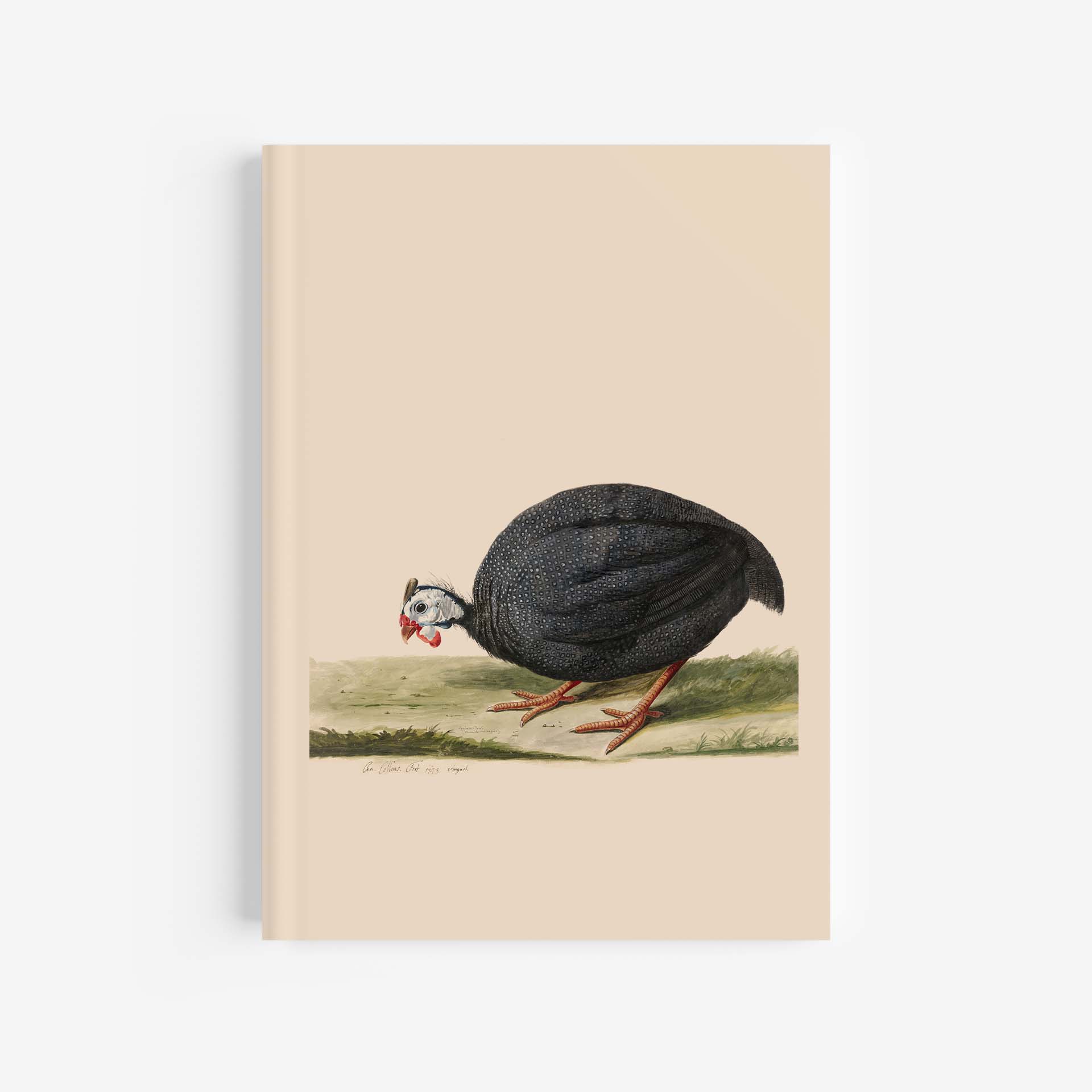


Guinea Fowl Journal / Notebook
A journal available in A4 and 5in x 7in sizes, with plain or ruled paper. The cover shows a charming Guinea Fowl looking out over its back, painted by wildlife artist Charles Collins (c.1680 – 1744).
Beautiful Guinea Fowl Journal / Notebook
Discover the boundless creativity within you with our Guinea Fowl Journal / Notebook. More than a notebook, it is an invitation to write, plan, sketch, and think on paper.
One of the true joys of these journals, aside fro the beautiful artwork on the covers, is the superb quality of the paper. If you like to use a fountain pen, then these journals are perfect for you. The pen glides over the paper, giving excellent feel and control as you write. If you prefer a ballpoint or other type of pen, teh paper will feel equally top quality to you.
Available in two sizes, A4 and 5×7 inches, our Guinea Fowl Journal / Notebook features a striking Guinea Fowl design on a premium vinyl laminated cover, with a matte finish that combines durability with understated style. Whichever size suits your routine, the interior offers 64 pages (128 sides) of 90gsm paper, chosen to give a smooth, consistent writing surface with minimal bleed or smudging, whether you prefer fountain pen, ballpoint, or fineliner.
Choose ruled or plain pages to suit the way you work, from structured note-taking to free sketching. The sturdy chipboard cover, wrapped in a vinyl laminate finish, is built to withstand daily use whilst keeping the Guinea Fowl artwork crisp and vivid.
Guinea Fowl Journal / Notebook Specifications
- Available in two sizes: A4 (21cm x 29.7cm / 8¼in x 11¾in) and 5×7in (12.7cm x 17.8cm)
- Spine width: approximately 1.27cm (half an inch) for durability and a premium feel
- Pages: 64 pages (128 sides) of 90gsm paper
- Paper type: available in plain or ruled
- Hardback Cover: sturdy chipboard overlaid with a vinyl laminate, featuring the unique Guinea Fowl design
- Free UK shipping
* Please note that the website images of the Guinea Fowl (above) are low resolution for illustrative purposes. The Guinea Fowl Journal / Notebook uses very high resolution images to give the finished notebook a crisp and clear finish.
** The Journals are only available in the UK at present.
The Taylor White Collection's 18th Century Watercolour Painting of the Guinea Fowl
Our Guinea Fowl comes from the original collection of Taylor White F.R.S. (1701-1772). In the mid-18th Century, White commissioned the celebrated wildlife painter Charles Collins (c.1680 - 1744) to paint a number of specimens for his collection. The watercolour of the Guinea Fowl was among the works Collins produced for White.
The original Guinea Fowl watercolour is finely painted, with remarkable detail, allowing the plumage and features of the Guinea Fowl to be seen in stunning clarity. This depth of colour and detail has been captured brilliantly through the digitisation process and is replicated here for your home or office decor, or as a thoughtful gift.
Taylor White, a barrister by profession and later Puisne Judge for Chester, was a keen naturalist and Fellow of the Royal Society, elected in 1725. Over nearly forty years from the 1730s until his death in 1772, he commissioned 938 watercolours of birds, mammals, fish and reptiles, including the Guinea Fowl, now held at McGill University and painted almost entirely by two artists, Charles Collins and Peter Paillou. White was a founding governor of The Foundling Hospital in London and served as its treasurer for the last twenty-five years of his life. His well-connected social and scientific circle gave his artists exceptional access to specimens: his second wife, Frances Armstrong, was the daughter of General John Armstrong, Governor of the Tower of London and Chief Royal Engineer, and White's artists painted the lions, wolves and other animals of the Royal Menagerie there. He also borrowed specimens from the British Museum, and received rare and exotic birds from friends, including the naturalist Joseph Banks, who sailed to Newfoundland in 1766, and William Harrison, who brought back specimens from voyages testing his father's marine chronometer.
About The Guinea Fowl
Charles Collins painted this Guinea Fowl in August 1743, one of the 18th Century watercolours held in the Taylor White Collection. Numida meleagris is an unmistakable bird: dense grey plumage flecked with white, a small bare head crowned by a bony casque, and the heavy bill and legs of a species that spends its life on the ground. Native to sub-Saharan Africa and carried worldwide through domestication, Guinea Fowl are sociable birds, moving in flocks known as a “confusion” and keeping contact through a loud, carrying call. Collins renders the speckled plumage with real patience, describing each mark rather than suggesting it, and gives the bird the stance and weight of a living animal.
Production & Delivery
All Guinea Fowl Journal / Notebook orders are produced in the United Kingdom.
From the point of order, the production of your Guinea Fowl Journal / Notebook will take 2-3 working days. It will then be despatched to you, arriving approximately 48 hours later.
Reviews
There are no reviews yet.